
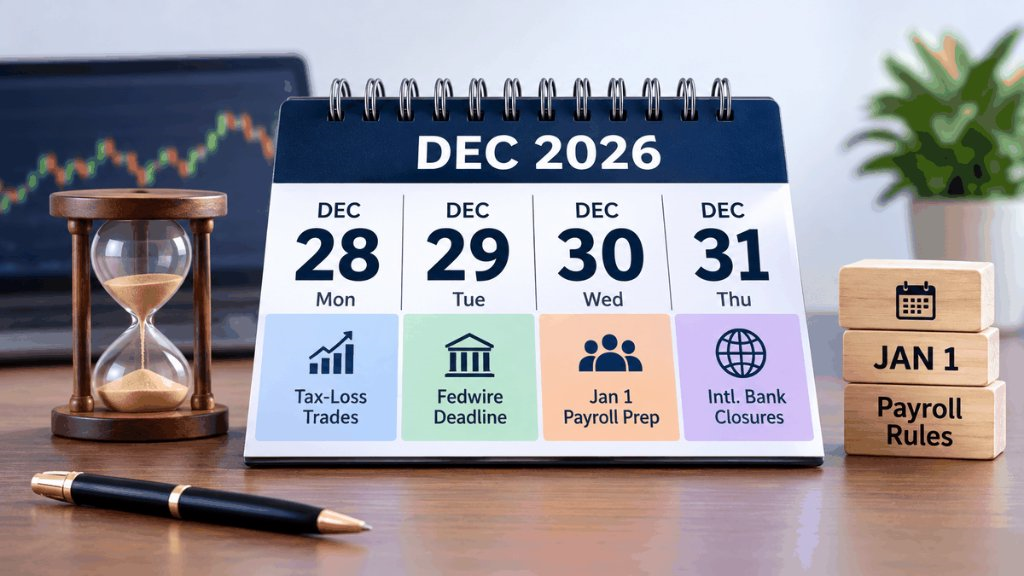
When I audited the December 28 to December 31 clearing schedules across our 48-country chronometry API, the final four weekdays of 2026 stood out as the easiest week of the year to accidentally trigger a tax-year mistake or a stranded international wire. Most calendar sites just tell you that New Year's Eve is not a federal holiday and stop there. In practice, that half-answer costs investors and payroll teams real money.
In 2026, New Year's Day (January 1, 2027) falls on a Friday. That single calendar alignment creates a chain reaction across US tax-loss harvesting, biweekly W-2 payroll reporting, and cross-border bank wires. Below is the exact breakdown I built into our year-end rules engine, starting with a quick checker so you can verify your specific transaction in five seconds.
Check Your 2026 Year-End Cutoff
Select the exact transaction you need to clear before 2027 to see the real submission deadline, settlement date, and tax-year impact.
US Stock Tax-Loss Harvesting (NYSE & Nasdaq)
Counts for 2026 Tax YearUnder IRS Revenue Ruling 93-84, capital gains and losses are locked by the trade execution date, not the cash settlement date. You do not need to sell early on Dec 30. Any regular-session sale filled by 4:00 PM ET on Thursday, Dec 31 counts on your 2026 Schedule D.
2. Master 4-Day Matrix: Dec 28 to Dec 31, 2026 Across Major Hubs
The biggest mistake I see in year-end operations is assuming that because New York is open, the rest of the world is open too. Between Monday, December 28 and Thursday, December 31, 2026, there are only two calendar days (Tuesday, Dec 29 and Wednesday, Dec 30) where all major Western and Asian financial hubs are open simultaneously.
| Country / Hub | Mon, Dec 28, 2026 | Tue, Dec 29 & Wed, Dec 30 | Thu, Dec 31 (New Year's Eve) | Fri, Jan 1, 2027 |
|---|---|---|---|---|
 United States (US Hub) | OPEN (Full Day) | OPEN (Full Days) | NYSE/Fedwire: OPEN SIFMA Bonds: 2:00 PM ET | CLOSED |
 United Kingdom (UK Hub) | CLOSED (Boxing Day Sub) | OPEN (Full Days) | LSE: Early Close 12:30 GMT CHAPS & Bacs: Open | CLOSED |
 Canada (CA Hub) | CLOSED (Boxing Day Sub) | OPEN (Full Days) | TSX & Lynx: OPEN (Full Day) | CLOSED |
 Germany (DE Hub) | OPEN (Full Day) | OPEN (Final 2026 Days) | Xetra & Banks: CLOSED (Wholesale TARGET2 open) | CLOSED |
 Switzerland (CH Hub) | OPEN (Full Day) | OPEN (Final 2026 Days) | SIX Exchange: CLOSED Banks: Closed / Reduced | CLOSED |
 Brazil (BR Hub) | OPEN (Full Day) | OPEN (Final 2026 Days) | B3 & Banks: CLOSED (PIX runs 24/7) | CLOSED |
 Japan (JP Hub) | OPEN (Full Day) | OPEN (Final 2026 Days) | TSE & Banks: CLOSED (Banking Act Dec 31 - Jan 3) | CLOSED |
 Australia (AU Hub) | CLOSED (Boxing Day Addl) | OPEN (Full Days) | ASX: Early Close 2:10 PM AEDT RBA RITS: Open | CLOSED |
3. The T+1 Tax-Loss Harvesting Myth: Trade Date vs. Settlement Date
Every December, I see retail investors on Reddit and X panicking on December 29 or December 30, convinced they have to sell losing stocks a day early so the cash settles before midnight on December 31 under T+1 settlement rules. That is a myth.
Under IRS Revenue Ruling 93-84, the tax year for a public stock or ETF sale is determined strictly by the trade execution date, not the settlement date. Because the New York Stock Exchange and Nasdaq run a full regular session on Thursday, December 31, 2026 from 9:30 AM to 4:00 PM ET:
- Equities and ETFs: Any sale executed before 4:00 PM ET on Thursday, December 31, 2026 counts for the 2026 tax year, even though the cash will not settle in your brokerage account until Monday, January 4, 2027 under SEC Rule 15c6-1 (T+1).
- The Real Trap (Wash-Sale Rule & Mutual Funds): If you sell a stock at a loss on December 31, 2026, you cannot buy back a substantially identical security until Monday, February 1, 2027 (30 calendar days later) without triggering an IRS wash-sale disallowance. Also, if you are selling a mutual fund rather than an ETF, your order must be entered before the 4:00 PM ET NAV cutoff on December 31.
- What About Short Sales and Options? Short sales closing at a gain or loss also lock on the trade date (December 31). If you hold expiring options or need to exercise contracts, check your broker's internal New Year's Eve exercise cutoff (usually 4:30 PM to 5:00 PM ET).
If you only care about locking a 2026 tax loss, selling at 3:55 PM ET on Thursday, December 31 is completely fine. However, if you actually need the settled cash in your checking account before 2027 (for example, to fund a 2026 charitable donation or a year-end IRA/529 contribution), you must sell by Wednesday, December 30, 2026 so your T+1 cash settles on Thursday morning, December 31 in time for a same-day bank wire.
4. The Friday, Jan 1, 2027 Payroll Trap (IRS Constructive Receipt & 27 Pay Periods)
If you run payroll for a US company on a weekly or biweekly Friday schedule, Friday, January 1, 2027 is the most dangerous payday on the calendar. Because January 1 is a Federal Reserve holiday, Nacha ACH cannot settle direct deposits on Friday.
Normally, when a Friday payday lands on a holiday, payroll admins automatically move the pay date one day earlier to Thursday. If you do that here and pay your team on Thursday, December 31, 2026, you trigger the IRS Constructive Receipt Doctrine (26 CFR Section 1.451-2):
- The Wages Move Into Tax Year 2026: Under IRS rules, wages are taxed in the calendar year the employee actually receives or has unrestricted access to the funds, regardless of when the work was performed. Moving a January 1, 2027 payday to December 31, 2026 forces that entire payroll run onto your employees' 2026 Form W-2s and your Q4 2026 Form 941.
- The 27-Pay-Period Collision: For biweekly employers, advancing January 1 into December 31 can create a 27th pay period in 2026, which can cause salaried employees to overshoot annual 401(k), HSA, or FSA contribution caps if your payroll software does not cap deductions automatically.
- Your Two Clean Options: If you want the wages reported in 2026, set the Nacha Effective Entry Date to Thursday, December 31, 2026 and submit your T-2 ACH file by Tuesday, December 29, 2026. If you need those wages to stay in the 2027 tax year, set the Effective Entry Date to Monday, January 4, 2027 and notify employees in early December so nobody is surprised by a Monday deposit. You can test exact submission dates in our Global Payday & Payroll Cutoff Calculator.
5. Global Wire Shutdown: Why Dec 30 Is the Real Cutoff for Europe, Brazil & Japan
If you pay international contractors, overseas suppliers, or distributed teams, December 31 is not a global business day. When I built our Cross-Border Wire & Settlement Simulator, I noticed two completely opposite freeze zones during the final week of December 2026:
- Freeze Zone 1 (Monday, Dec 28 in the UK, Canada & Australia): Because Boxing Day (Dec 26) falls on a Saturday in 2026, the UK, Canada, and Australia all observe a substitute bank holiday on Monday, December 28, 2026. If a US client sends a wire to London, Toronto, or Sydney on Monday morning, their US bank marks it as sent, but the receiving central bank (CHAPS, Lynx, or RITS) is closed until Tuesday, December 29.
- Freeze Zone 2 (Thursday, Dec 31 in Germany, Switzerland, Brazil & Japan): Commercial banks and exchanges in Germany, Switzerland, Brazil, and Japan treat December 31 as a year-end bank balance-sheet closure. Any wire sent from New York to Frankfurt, Zurich, Sao Paulo, or Tokyo on December 31 will sit in correspondent queues until Monday, January 4, 2027. To guarantee 2026 receipt in those countries, initiate your transfer no later than Wednesday, December 30, 2026 before your bank's morning FX cutoff.
6. Fedwire, Nacha ACH & SIFMA Bond Market Hours on New Year's Eve
Inside the United States, Thursday, December 31, 2026 is a regular Federal Reserve business day, with one important fixed-income exception:
- Fedwire Funds Service: Open normal hours (closing at 6:30 PM ET for third-party customer wires and 7:00 PM ET for bank-to-bank settlement). However, most commercial banks enforce internal online wire cutoffs between 3:00 PM and 5:00 PM ET on New Year's Eve.
- Nacha ACH & Same-Day ACH: Open full normal windows on December 31, including the final 4:45 PM ET Same-Day ACH submission window.
- SIFMA US Bond Market: Closes early at 2:00 PM ET on Thursday, December 31, 2026.
- USPS, UPS & FedEx: USPS delivers regular mail on December 31 (post office lobbies may close early). UPS and FedEx operate modified New Year's Eve schedules (primarily Air/Express deliveries with limited Ground pickups) before shutting down completely on Friday, January 1, 2027.
7. Official IRS, Federal Reserve & Exchange Verification Sources
- Federal Reserve Financial Services: Official 2026-2027 Fedwire & FedACH Holiday Schedule
- New York Stock Exchange (NYSE): Official Trading Hours & Holiday Calendar
- SIFMA: Official US Fixed-Income Early Close Recommendations
- IRS Publication 550: Investment Income and Expenses (Trade Date vs. Settlement Date)
- IRS Publication 15 (Circular E): Employer's Tax Guide & Constructive Receipt Rules
Sources & Statutory Methodology
Year-end settlement and tax-year rules in this guide are cross-verified against IRS Revenue Ruling 93-84, 26 CFR Section 1.451-2 (Constructive Receipt), SEC Rule 15c6-1 (T+1 Settlement), Federal Reserve Operating Circulars No. 4 and No. 6, NYSE Rule 7.2, SIFMA 2026 Recommendations, and official 2026-2027 calendars from the Bank of England, Payments Canada, Deutsche Boerse, SIX Swiss Exchange, ANBIMA/B3, and the Bank of Japan.